Embedl's build black-forest-labs/flux-2-klein-4b of the original model black-forest-labs/FLUX.2-klein-4B
Embedl-optimized


- huggingface
- FP8 + BF16 + FP16
- AGX Thor
- Labels
- Text
- Image
- Generation
- Build
- Embedl-optimized
- Precision
- FP8 + BF16 + FP16
- Runtime
- TensorRT 10.16 with Embedl optimizations
- Resolution
- 512×512, 4 steps
Generated by this build
Ran on AGX Thor, this build
seed 42
--prompt
A red ceramic teapot and a blue cup on a sunlit wooden table.
seed 314
--prompt
A tiny observatory on a mossy hill under a clear starry sky, watercolor illustration.
seed 2718
--prompt
A neatly arranged collection of colorful glass marbles on white paper, studio photograph.
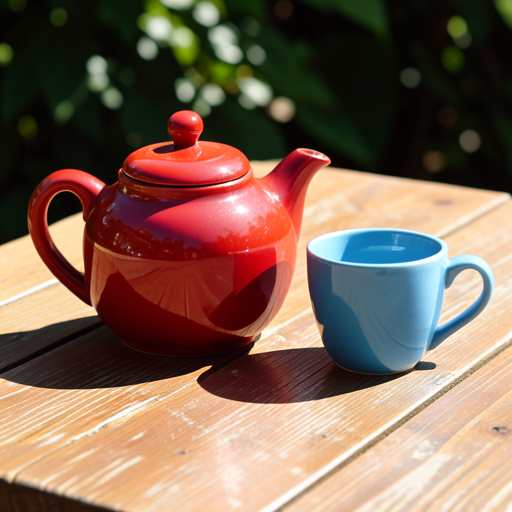


FLUX.2 [klein] 4B is Black Forest Labs' text-to-image model: it generates a 512×512 image from a text prompt in four distilled steps.
Checkpoint e7b7dc27f91deacad38e78976d1f2b499d76a294 (Apache-2.0); Qwen3-4B and the VAE are Apache-2.0.
Methodology
- Latency: 200 held-out prompts after three warm-ups, 512×512, batch 1, four distilled steps, guidance 1.0; synchronized wall time from prompt to encoded PNG, no embedding cache.
- Accuracy: 200 PartiPrompts with fixed seeds and identical explicit noise in the upstream BF16 reference. CLIP ViT-B/32 CLIPScore (100×max(cosine, 0)); paired delta −0.061, 95% CI [−0.206, 0.081]. CLIP-FID on generated sets against BF16: an exploratory comparison at n=200, not real-image FID.
- Memory: peak RSS of the serving process; TensorRT device bytes from a separate untimed allocator pass, including I/O buffers but not CUDA context. On unified memory the two are not additive.
- Baseline TensorRT: the upstream model in BF16/FP16 on TensorRT, same settings, same device: not measured yet.
- Precision: the denoising transformer uses Embedl Deploy FP8, calibrated on 32 disjoint PartiPrompts; the Qwen3-4B text encoder stays BF16 and the VAE FP16.