Embedl takes any Hugging Face model to NVIDIA Jetson in a single step
· 5 min read
Getting a model from Hugging Face onto a NVIDIA Jetson used to take weeks. Now it is one step: type the model id, pick the Jetson, run it, from the browser or with one copied command. Over 1,000 models are ready, each optimized for the Jetson it runs on: NVIDIA’s Cosmos 3 Edge, for one, runs at over 150 tokens per second on the 8 GB Jetson Orin Nano Super.
BERLIN, 21 October 2026 (NVIDIA GTC Berlin). Embedl today opened its platform to the public at embedl.com, to accelerate the adoption of physical AI on NVIDIA Jetson. On one page, type a Hugging Face model id, pick a Jetson, and the model runs: from the browser, on a real Jetson in Embedl’s device farm, or on your own kit, with one copied command that pulls the compiled model and a lightweight runtime container. Over 1,000 optimized models are ready to run, infer and profile on a real Jetson. Any other Hugging Face model is queued and shortly after joins the catalog, ready to run. Each model is optimized for the Jetson it runs on, so the same single step also delivers resource-efficient AI on the device: less compute, memory and energy for the same task.
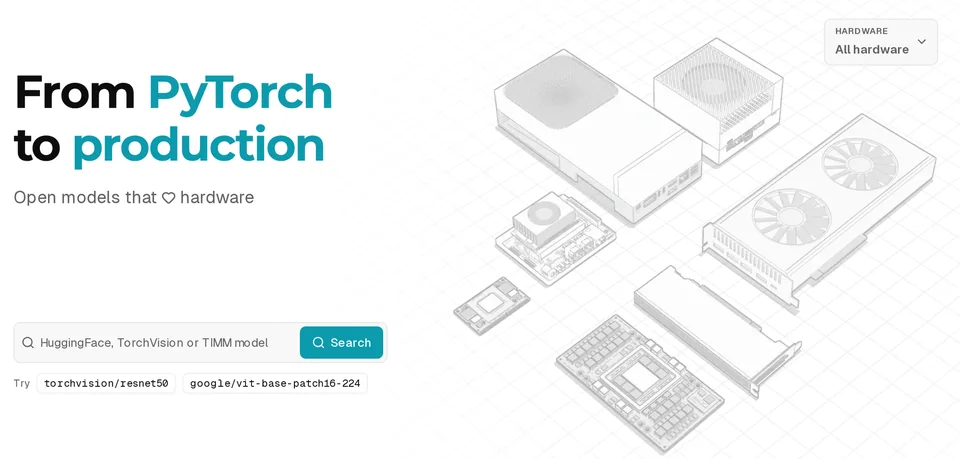
Figure 1. The start page at embedl.com: one field for any Hugging Face, torchvision or timm model id, next to the hardware it will run on.
Getting a model from Hugging Face onto a Jetson used to take a team days to weeks, per model and per device, and the results rarely got published. Embedl publishes its results, speed and accuracy side by side, across perception, speech, language, vision-language and robot action. Examples: DINOv3, SAM3 and RF-DETR for perception, Parakeet for speech, Qwen3.5, and NVIDIA’s open models such as Nemotron and Cosmos Reason 2 for language and vision-language, and Cosmos 3 Edge for robot action.
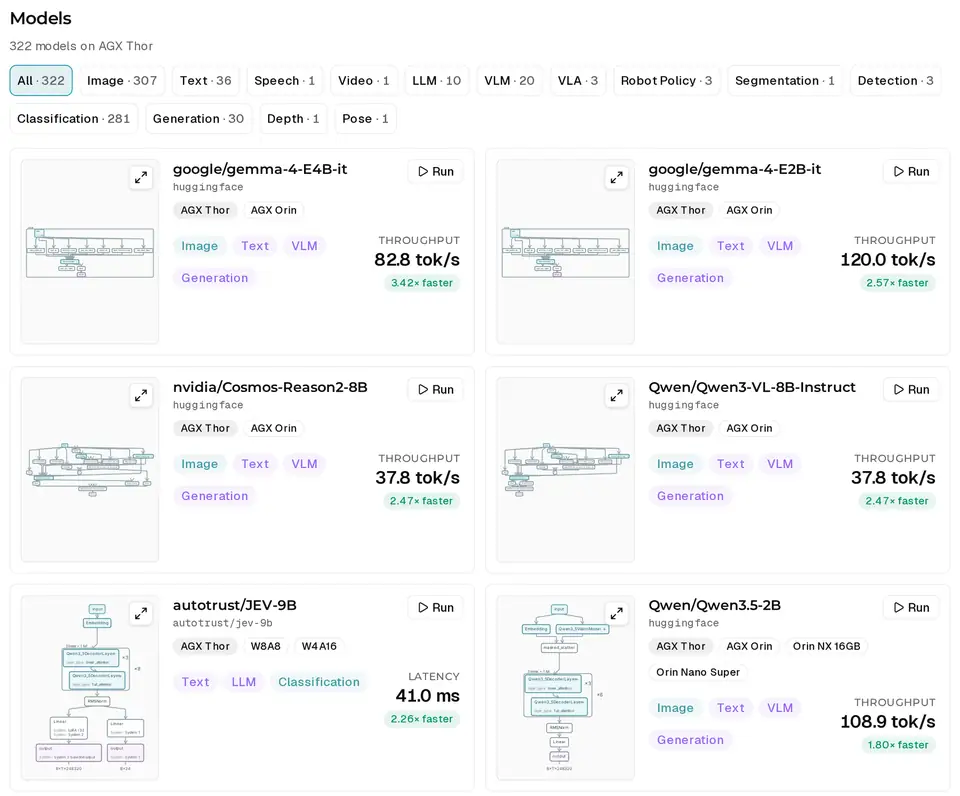
Figure 2. The catalog, here for Jetson AGX Thor: each model with its measured speed and its speed-up over the baseline.
On a model page, Visualize shows the optimized graph layer by layer, and Deploy offers three ways to run: Copy commands for your own Jetson, Try it to run your own data on a real Jetson in Embedl’s device farm with the numbers written back to the page, or add your own machine as a runner. The farm holds NVIDIA Jetson AGX Thor, AGX Orin, Orin NX and Orin Nano Super, so a team sees the same model on every Jetson it fits and knows which one to order. No other public platform pairs optimized models with real Jetson devices, from the flagship AGX Thor to the 8 GB Orin Nano Super. The public platform is the quick path: a model goes from Hugging Face to a running Jetson in one step. Embedl Hub, the on-premises version, is for teams that build on the result. It holds the full lineage of every optimized model, every step from the original checkpoint to the compiled artifact, so a team can fine-tune on its own data, re-run the same optimization and ship the result with the traceability that regulated industries require.
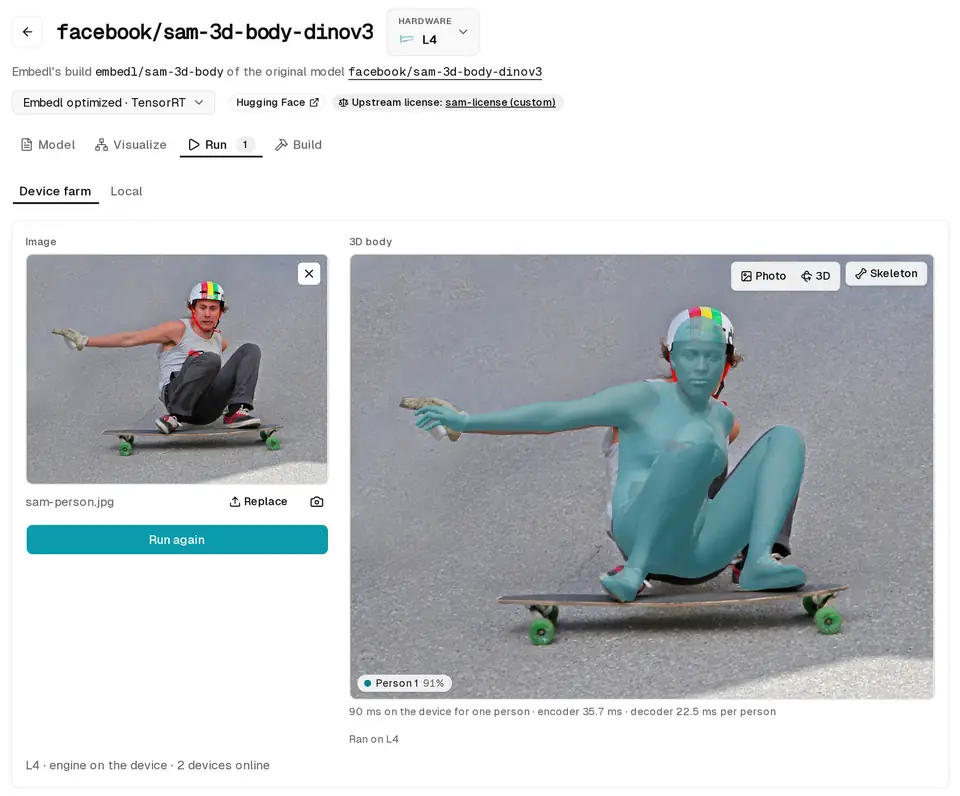
Figure 3. The Run tab for SAM 3D Body on an NVIDIA L4 in Embedl’s device farm: one photo in, the person recovered as a 3D body mesh in 90 milliseconds on the device, with Embedl’s optimized TensorRT build.
Every model on the platform is optimized for the Jetson it runs on, with the accuracy published next to the speed. NVIDIA Cosmos 3 Edge, NVIDIA’s open physical AI model for Jetson, shows how far that goes: it reasons about images and video, generates video and produces robot actions, and all three run on the platform. On Jetson AGX Thor it generates 208 tokens per second, with accuracy within 0.4 points of the original on average over five vision-language benchmarks, measured on every Jetson in the farm. That is three times the 68 tokens per second NVIDIA’s Jetson AI Lab reports for the original BF16 model on the same Thor. On the 8 GB Jetson Orin Nano Super it generates 152 tokens per second, 5.7 times the original FP16 model on the same runtime and the first published rate for the model on that board. Embedl’s builds run on NVIDIA TensorRT and NVIDIA TensorRT Edge-LLM, the runtimes NVIDIA ships with Jetson.
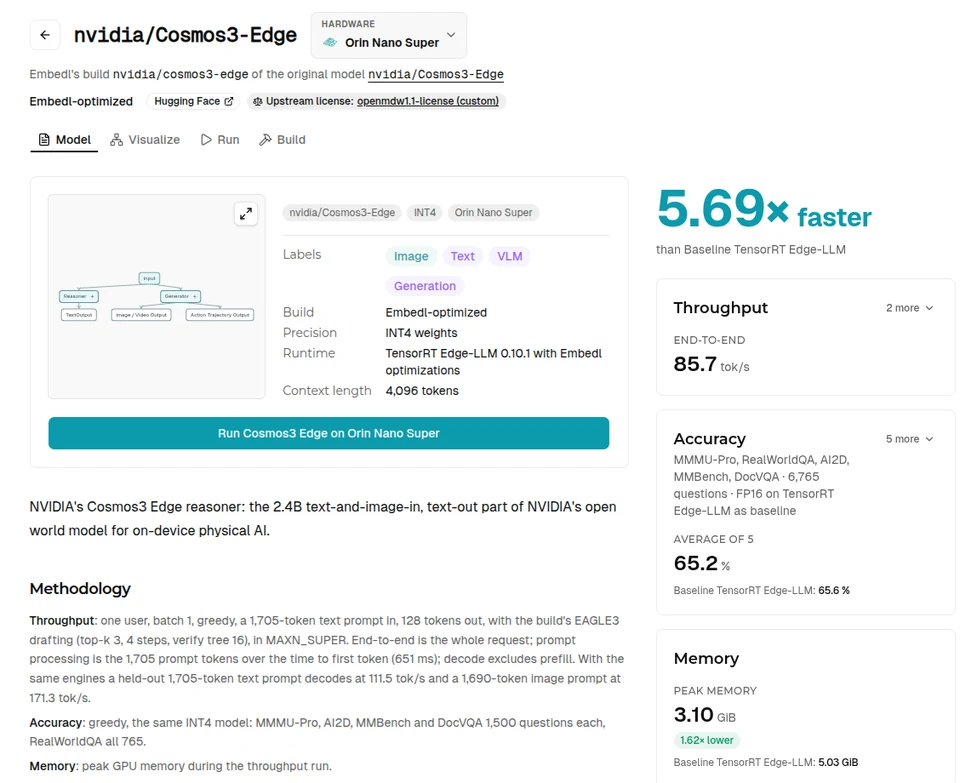
Figure 4. Cosmos 3 Edge on Jetson Orin Nano Super: throughput against the BF16 reference, and accuracy over five benchmarks.
The launch builds on two results this year. hfviewer, Embedl’s tool that turns a Hugging Face model id into a visualization of the model, has drawn over 150,000 visits, and Embedl’s optimized build of NVIDIA Cosmos Reason 2 has passed 60,000 downloads on Hugging Face, both as of 30 September 2026. The platform starts from the same model id and ends with the model running on a Jetson.
“A physical AI product is a model on a device, and that is where it has to work,” “NVIDIA has built the hardware and released the models. We take a model from Hugging Face to the Jetson in one step, publish the accuracy with the speed, and hand over the command. A team knows which Jetson their model needs before they order one, and runs the same model on their own kit.”
said Hans Salomonsson, CEO of Embedl.
The public platform is live at embedl.com and free to use. Embedl demonstrates the platform at booth 7067 at NVIDIA GTC Berlin on 21 and 22 October.
About Embedl
Embedl builds the infrastructure that takes physical AI from PyTorch to production. Its platform gives developers optimized models that run on real edge devices, with on-device benchmarks. Embedl Hub brings the same workflow on premises, with experiment tracking and the traceability that regulated industries require. Founded in 2018 in Gothenburg, Sweden, with an office in Palo Alto, the company works with automotive, space, robotics and defense companies, and is a member of the NVIDIA Inception program.
Press contact: Ola Tiverman, ola@embedl.com